


Ed. note: First published at Biotic Regulation and the Biotic Pump. Reposted, with introduction by Rob Lewis, at The Climate According to Life.
Antonio Donato Nobre has dedicated his professional life to studying and advocating for the Amazon, producing in 2014 the widely heralded report, The Future Climate of Amazonia and helping to elucidate the biotic pump mechanism. Retired now, he apparently feels less confined to the careful language required of the publicly-employed scientist, writing this no-holds-barred critique of COP30 and the carbon “tunnel vision” it still clings to.
There is an “elephant in the room,” he declares, an “inexplicable omission.” It stands unheeded in every meeting and report “narrowly set on carbon emissions and net-zero pledges.” The elephant at COP30 is ecosystem destruction, “the systemic sabotage of the planet’s most powerful climate control mechanism.” No one sees the elephant because it’s been continually “relegated to a mere footnote in the carbon story.”
These are strong words, and that’s only the first two paragraphs. He goes on to make a powerful case for the “regenerative power” of living systems and their “unconceivably complex and incredibly sophisticated mechanisms.” “Recognizing this prowess must become the gauging sign of our own existential intelligence,” he says.
While the content of his piece is powerful enough, it’s the tone that particularly strikes me. It suggests anger, exasperation and disbelief that what is clear to a growing number of scientists around the world remains strangely absent from the official climate orthodoxy.
In an email thread with other scientists and supportive citizens, Czech scientist, Jan Pokorny, recently observed that “Over the past twenty years, a scientific field has developed that explains the role of water and forest ecosystems (vegetation) in the distribution of solar energy, the water cycle, and climate formation…” Arguably, it goes back even further, to the early 1970’s, when climate reports clearly pointed to land disturbance as a first order, human cause of climate change. Yet, this understanding is still left out of the discussion, recategorized under the headings of “mitigation” and “adaption,” side shows in an entirely CO2-run climate drama.
To be clear, none of this changes the reality that CO2 emissions pose a serious threat to Earth’s climate system. They just aren’t the only threat. And it’s time to understand that. As Nobre puts it: “This is the critical juncture where the world must finally elevate ecosystem protection and recovery from a peripheral concern to the core of global climate action.”
Will the climate movement, and environmentalism in particular, finally hear this call?
The Amazon’s Climate Engine is Dying: Why COP30’s Carbon Obsession is a Catastrophic Blind Spot
By Antonio Donato Nobre, 10/November/2025 Directly from COP30, Belém, Brazil
Nov 10, 2025. First posted at Biotic Regulation and Biotic Pump
As COP30 convenes at the heart of the Amazon, the world’s focus is narrowly set on carbon emissions and net-zero pledges. Yet, this tunnel vision blinds us to the most important elephant in the room: Ecosystem destruction is not a carbon problem alone—it is the systemic sabotage of the planet’s most powerful climate control mechanism.
Since 2023, extreme weather events have shattered IPCC model projections, and meteorologists are now grappling with this new reality. Standard climate models were designed in a stable world that we have irrevocably left behind. But wait, even in the stable climate there was an inexplicable omission: the dynamic land-atmosphere water cycle—powerfully mediated by living forests—relegated to a mere footnote in the carbon story.
When Trees Hold Up the Sky
Indigenous knowledge has long understood what science is only now proving. Davi Kopenawa Yanomami once told me based on his The Falling Sky book: Don’t white people see that if they cut down the forest, the rain will dry up?
This isn’t metaphor—it’s native wisdom summing up the physics of the Biotic Pump. Forests function as the beating heart of the hydrological cycle. Trees transpire vast volumes of water vapor, which rises and rapidly condenses into clouds, aided by cloud-seeds also emitted by the plants. When vast amounts of water vapor rise and condense back into liquid droplets (clouds), that liquid takes up vastly less volume than the gas did. This sudden shrinkage creates a low-pressure area—a massive natural vacuum—that efficiently pulls humid air from the oceans deep into the continents.
The Biotic Pump theory was pioneered by Russian scientists Anastassia Makarieva and Victor Gorshkov, in close cooperation with Brazilian researchers, including myself. Our studies have revealed this mechanism operates globally. In the Amazon, the pump pulls trade winds from the North Atlantic across the equator, penetrating deep into South America. In Siberia, boreal forests maintain the Eurasian flying rivers —crucial atmospheric moisture sources for vast portions of Europe, China, and Central Asia. This profound, life-or-death physics—the Biotic Pump—is not a newly formulated hypothesis; it is a solid mechanism, a published theory, rooted in fundamental physics. Yet, for nearly two decades, this critical dynamic has been missing in the dominant global climate models. This omission has allowed models to wildly underestimate the Amazon’s vulnerability and the speed of climate collapse, precisely due to the reluctance to integrate a truth that challenges the carbon-centric foundation.
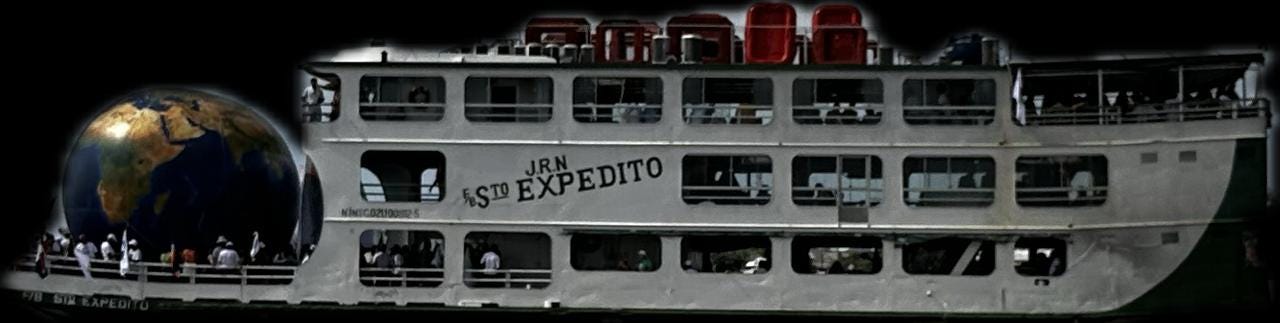
A COP30 boat in the Amazon. But the sky turned black
Destroying a Friendly Climate
Remove the trees, and the pump breaks. Transpiration stops, dry air falls, humid air is no longer drawn inward, clouds vanish, the natural cooling system collapses, and menacing, massive bubbles of hot air settle over deforested regions, further blocking humidity circulation and triggering desert-like conditions across vast continental areas. Where dense white clouds over the Amazon once reflected up to 70% of solar radiation back to space, bare ground now absorbs that heat. This process dramatically amplifies regional warming, generating vicious climate consequences far beyond what carbon emissions alone can explain.
Beyond Carbon: A Paradigm Shift for Climate Action
Here is the uncomfortable truth: Even if we zeroed out carbon emissions tomorrow—a goal certainly worth pursuing—without massive ecological restoration the climate emergency would persist. While carbon dioxide is key to long-term warming, ecosystem destruction introduces a dangerous short-term multiplier. By damaging the ocean-atmosphere-land water cycle we drastically amplify the climate’s sensitivity to CO2. Forests aren’t just carbon sinks. They are the planet’s primary climate regulators, its freshwater generators, and the very foundation of continental habitability.
The Path Forward: Protecting and Restoring the Biosphere
The good news is that Life has the regenerative power. Over 400 million years, the biosphere has conquered continents through unconceivably complex and incredibly sophisticated mechanisms. Spores, seeds, shoots, branches, leaves, eggs and precious cultures of Indigenous Peoples hold the secrets of life to maintain and safeguard the climate. Recognizing this natural prowess must become the gauging sign of our own existential intelligence.
This mandate requires fundamentally reforming agriculture and cattle ranching—currently the main vectors of destruction. Furthermore, the failure to model the Biotic Pump has a direct financial consequence: It allows billions to be funneled into bogus, short-term carbon offset schemes—such as tree farms that fail to replicate the complex hydrology of native forests—which look good on a carbon ledger but do nothing to restore the planet’s water cycle.
Think of it like treating a liver disease. The first thing a doctor tells the alcoholic is to stop drinking—that is, stop polluting, stop destroying. This is essential, but it is wholly insufficient. The damaged liver needs healing. If we continue losing and degrading our forests, no amount of monoculture replanting or carbon offsetting will preserve planetary health. A damaged liver can regenerate—but it needs help. Nature had eons to spare; we do not.
COP30’s Historic Opportunity: The Final Mandate
Hosting COP30 in the Amazon is more than symbolic—it’s strategically essential. The challenge for Belém is clear, yet momentous: Will we finally acknowledge the elephant in the room? The world is watching to see if the rhetoric of ‘preservation’ will trump the 20th-century craving for reckless development. Will we give up political convenience and overcome economic cynicism? This is the critical juncture where the world must finally elevate ecosystem protection and recovery from a peripheral concern to the core of global climate action. New humane partnerships must recognize the extraordinary capacity of intact land ecosystems to cool the surface—magnificently converting water vapor into clouds and rain, an ultra-complex function that no man-made technology can replicate or substitute.
The mandate for COP30 is not about if we value the Amazon, but how we value it. We must enforce, fund, and model policies that recognize the forest not merely as a carbon repository, but as the planet’s irreplaceable air conditioning and freshwater generation system. The stability of the world’s food, water, and climate depends on whether Belém elevates biogeophysics— as shown by the new science of the Biotic Pump—from a peripheral concern to the core of global climate law. Give diverse forests a chance, give native territories a stand, and they will heal the climate. This conviction is not naive optimism; it emerges from the practical application of physics, deep ecology, ancient wisdoms and four billion years of evolutionary genius.
Will we finally commit—without compromise—to fully respect, protect and restore our marvelous planet?