

Nobody really starts from scratch. We so often resolve to do so because it gives us license to break with tradition, to get creative. But even as we strain to nudge our imaginations into uncharted territory we must work with such materials as are at hand at that moment.
So it is with our thoughts for the future. As things fall apart around us, we of necessity must sift through the rubble to find what we need to live differently. That circumstance will challenge us to distinguish carefully between what is and is not worth salvaging, between what really will set us on a fresh trajectory and what will put us back on the road that, having once led to disaster, can only do so again. The odds that something useful – something truly innovative – might emerge will vary with the amount of wisdom we can muster to meet that challenge. Much will depend on what we will accept as a wise reckoning with pertinent facts.
I would like to examine an ideal that is proving to be remarkably tenacious, even as it graces a set of arguments that are becoming increasingly implausible. Universal religions and modern ideologies, despite their many differences, all contain a vision of some final consummation – a point in the future when everyone sees the light and an era of peace and goodwill dawns. Whether it’s the kingdom of God or the brotherhood of man, an end-of-history capitalist order or a classless society, such visions presume that social harmony can only prevail after a shared understanding of fundamentals takes hold in every mind and heart. This is one way to understand why the urge to proselytize tugs so powerfully on the consciences of so diverse a cast of characters as Christians, Marxists, and free market disciples. Or why those same consciences feel little remorse for the unspeakable violence – from the Crusades and the Inquisition to nation building and the gulag – visited upon those who did not wish to enter a promised land connected only by dubious hypotheticals to the world they knew.
The yearning for some overarching framework of universal values surfaces in the arguments of writers held in high regard by those who are otherwise skeptical of big structures and global blueprints. I think this paradox is noteworthy both as a matter worth pondering in itself and for its bearing on how degrowth localists approach policy and strategy. In each case, the key moment occurs when the writers pivot to address the shortcomings of small, rural, pre-modern communities that until then they have characterized in glowing terms. These critical comments serve two purposes: 1) to reassure the reader that the writers are not advocating a return to some primitivist Eden, and 2) to lay the groundwork for such correctives as they intend to propose for village parochialism. They will be familiar to anyone who has dared to argue in the present for a downsized future of some kind.
Lewis Mumford figures prominently among those who have taken turns chipping away at “the myth of the machine.” If one considers the things that make a human life meaningful, he argued, technological progress has more impoverished than enriched those who of necessity must adapt their hopes and habits to the logic of machinery if they are to make their way in a mechanized world. In Technics and Human Development (1966), he constructed a sweeping historical account of the evolution of tools and of the social and political institutions that hardened into place as component features. Midway through he paused to take a snapshot of “archaic village culture” – the label he chose for what technology’s march to the sea would destroy. It is hard to imagine a more rhapsodic rendering of Neolithic well-being. The inhabitants of these small places were rooted in the rhythms of the natural world and in a meaning-rich cycle of family and communal rituals and festivities. Work was performed in a spirit of companionship and “aesthetic delight,” neither “power nor profit” took precedence over enjoyment and ease, and all claimed an equal share in the rewards of belonging to “a visible, tangible, face-to-face community.” All in all,
[t]he extraordinary durability of neolithic village culture, as compared with the more daring transformations of later urban civilizations, bears witness to its having done justice to natural conditions and human capabilities better than more dynamic but less balanced cultures.
Mumford’s critique, the careful reader will notice, is already underway. “Daring” and “dynamic” mark the fault along which a summary condemnation of village life will erupt at the end of the chapter. The very “virtues” of such a social arrangement render it unfit as a potential remedy for what ails us in the present. The village is finally too “narrow a province” to support what Mumford, viewing it now from a height no villager ever attained, presumes virtuous. Ease and good will, commendable in principle, lead inevitably to “a slackening in effort and a falling off in productivity.” The simple reality of isolation breeds “narcissism,” “self-absorption,” and hostility to anything foreign. Condemned to the “perverse elaboration” of rituals performed to appease “petty ancestral gods,” the villager never comes to know anything “saintly” or “self-transcending to achieve some higher good.” Perhaps most damnably,
[t]he very stability and fruitfulness of such a community might cause it prematurely to cease experiment and settle down. Isolation, in-group loyalty, self-sufficiency – these archaic village traits do not make for further growth.
Historians are fond of shifting into the ironic mode to cast the virtues of one historical phase as vices when set loose within the next. Those who cling to them, whether as a tribal villager or a hillbilly homesteader, are hell-bent for history’s dustbin. They lack the “daring” that would gain them entry into the realm where the “dynamic” operates.
This argument only makes sense if one presumes that the course of history moves inexorably in a single direction. Why else would villagers going about their business appear “self-absorbed” while urban dwellers doing the same are experiencing “self-transcendence?” What makes the gods who connect the believer to an ancestral lineage and homeland “petty,” while a One and Only deity perched on a throne in the heavens creates for His followers the possibility of “saintly” conduct? How does an otherwise thoughtful observer convince himself that the creative spirit found no purchase in archaic villages or that its inhabitants were mired in slothful stagnation?
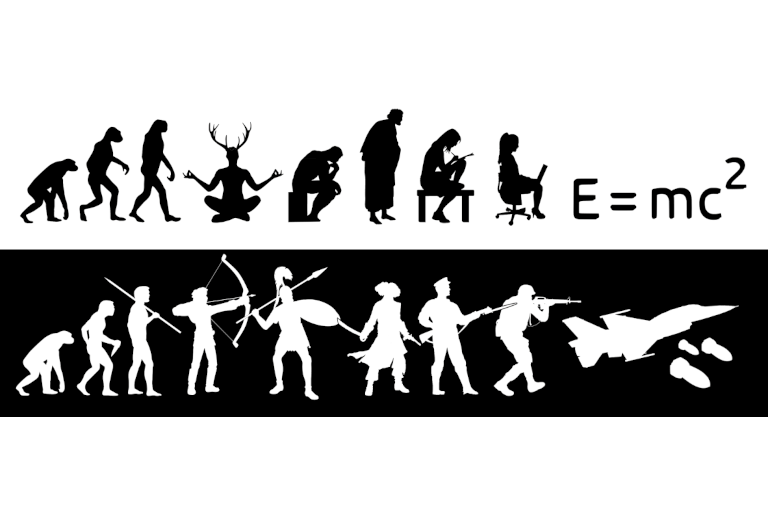
For these kinds of assertions to appear credible one must first imagine history moving stepwise from one level to the next, each one representing an advancement over the one preceding. One must, in short, believe in Progress.
Mumford is such a believer, and this circumstance shapes not only his characterization of the past but his sense of what it is reasonable to expect – and work for – in the future.
Technics and Human Development was published in 1966. At that time, new anthropological evidence was unsettling long-held views of life in “primitive” societies. The essays collected in Man the Hunter (1968) and Marshall Sahlins’ Stone Age Economics (1972) probably did the most to reorient scholarly opinion, especially the latter’s “The Original Affluent Society.” These anthropologists, drawing on a wealth of new field work, argued that hunter-gatherers enjoyed more leisure time, better health, and equal if not greater longevity than the inhabitants of agricultural settlements and urban centers. Conceived just as these conclusions were germinating in the journals, Mumford’s characterization of the archaic village suggests that he had caught wind of this revisionist scholarship. He surely would have been conversant with Margaret Mead’s best-selling studies, published decades earlier, of Polynesian culture. Whatever the inspiration, Mumford knew that life for those designated as “primitive” was far from nasty, brutish, and short. Yet he still felt obligated to condemn them as relics of a bygone era, positioned too far from the stream of history to be carried along in its currents.
The myth of Progress is a mighty force. Buy into it and you will soon find yourself at odds with what empirical investigation has revealed about the lives of hunter-gatherers, villagers, and rural people generally. However blighted the present, the myth requires that the past be portrayed in even more frightful terms. And the future must somehow bloom from the blight, not from a past that was home to healthy communities – at least until Progress reasoning kicked in and overruled the evidence-based account Mumford presented in the bulk of his chapter.
Mumford does imagine one useful legacy for the archaic village. The arts and crafts developed by these communities, he argues, might have value as “occupational therapy” – a method of teaching “neurotic patients” the value of “repetitive tasks” and “regular work.” That’s it for positive contributions to the future. All the life-affirming virtues he found are left to die with the small settlements that nourished them. In subsequent writings, he devoted most of his energy to figuring out how modern technology might be made more humane and large cities more livable. As a believer in Progress, it was simply inconceivable that modernity and urbanization per se might have fueled the very developments that, as a cultural critic, he so forcefully denounced.
In the sixty years since Technics and Human Development appeared, that realization has dawned in some quarters at least. The work that Sahlins and others began in the 1960s and 1970s has been taken up by hundreds of anthropologists. None of the archaic villages and hunter/gatherer settlements they have studied fit Mumford’s description of torpor and stagnation. Even the most remote were connected to trade networks that brought in goods from outside and these were bought or bartered for when they could be put to practical use. Any inquiry not addled by fantasies of ever-upward enlightenment would surely find more narcissism and self-absorption in the modern city than in the archaic village. From where we sit now, what Mumford credited as daring and dynamic – productivity, growth, and the kind of ceaseless experimentation that gets us self-driving cars, synthetic food, and chatbots – look more like engines of destruction than hallmarks of progress.
Yet our faith in Progress persists. It supplies logic and credibility to the arguments of ecomodernists, green transitioners, and anyone else who trusts technology to guide us through the disasters now unfolding and deliver us unscathed into a new and improved promised land of abundance. The universalism of such a faith derives from the certainty with which it is affirmed: who would be so foolhardy as to resist a force that, so the story goes, everywhere and at all times has swept everything before it? We are all carried along on the same tide of history, all bound for the same destination, the same shining city on a hill. To believe otherwise is to succumb to nostalgia and superstition. Down that path lies romanticism and all the lost causes of the past, terminating finally in the places where Progress cannot proceed – tribal homelands, country towns, highland freeholds, family farms …
… and Mumford’s archaic village. I have focused so intently on the sharp turnabout he performs in his evaluation of the pre-modern world because I believe doing so throws into bold relief the intellectual gymnastics that must be performed to sanctify the modern world. His maneuver propels us not just beyond the reach of available facts but of the very values that need to be preserved if we are to manage with any measure of wisdom the challenges we face. The secret to the success with which small rural settlements lived on the land for most of human history lies in the village virtues that he lauded only to then put out to pasture, like praise for the deceased in a funeral oration.
There is no going back and plenty we will happily leave behind. But there is also much of value to learn from those, in the past and the present, whose way of life does not call for ruination of the means of living. The myth of Progress prevents our seeking out that knowledge and making common cause with those who possess it. If we accept the terms it sets for understanding the course of human affairs, we confine our thinking to the possibilities forever latent in smarter and more powerful machines, more cleverly designed mega-cities. A belief system that refuses to acknowledge any limits on what it can accomplish is itself too constricted to grasp the limits imposed on human endeavor by the natural systems that condition all we have done and will do in the future. That is the narrowness we should fear.
Mumford had it backwards. It is the modernists, not the villagers, who are the “narrow provincials.” It is the believers in Progress who have chained daring and dynamism to petty purposes and passive self-absorption. That belief has bloodied the past and will do the same in any future built to its specifications. As Mumford’s example shows, it shackles the imagination of anyone, however well-informed and well-intentioned, who adheres to it. Of all the varieties of unfreedom currently in ascendance, that may be the most consequential, as it guarantees we will be overmatched when battling the others.