
I love nature. Birds, fish, flowers, trees, fungi, algae and even all the creepy crawlies wondering around in the bush and sometimes even inside my clothes. I don’t have lots of feelings towards bacteria but I still appreciate the fact that they’re there. My love and appreciation for these magnificent creatures isn’t only because of their majestic appearance, skills or strength. I just like to enjoy the finer things in life that nature provides me, such as breathing oxygen and eating food.
But industry nor economy don’t enjoy either. And their power in society is much greater than mine, or people like me. So, all of us, even the ones who don’t want it, end up destroying nature, polluting the Earth and accelerating climate change. Even with scientists speaking up about it and more planetary boundaries being crossed, society still wants more and more.
These conflicts of interests cause emotional distress for those of us that like eating and breathing, especially the youngest ones, who will face the brunt of the consequences of our actions. In the West there is a massive mental health crisis going on and in the East young people are giving up on their futures. This is obviously not just a result of a mental dilemma, but the harsh reality of facing the limits of growth. Many people are starting to see that the path in front of them is leading nowhere. Societal pressure is still trying to push people forward. But some of them are trying to stand their ground in the flow, while others are trying to find another path, a better way forward.

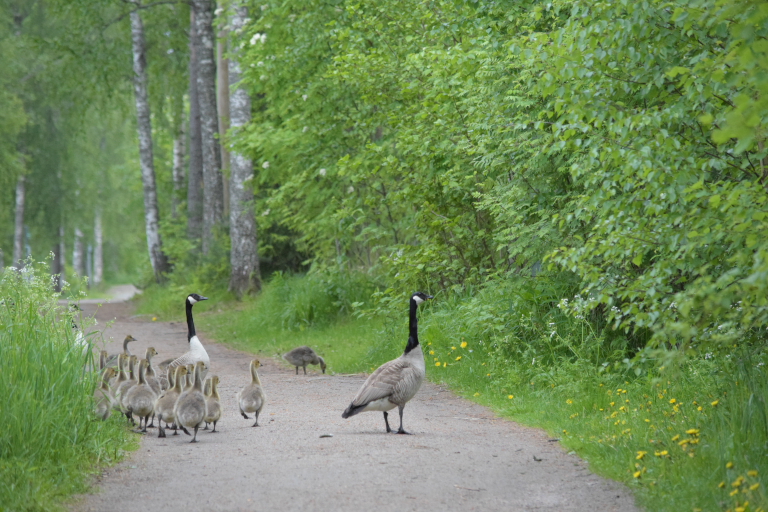
The sustainable path doesn’t have cars. Author supplied.
Which way?
The science is pretty clear. If any population of living beings isn’t ecologically sustainable, that population will crash. That goes for bacteria, beavers, birches and bees. And humans. The number one rule of all human societies should be to be sustainable.
I am not a powerful man and I can’t do much to change society. I can vote, write and try to convince my friends and family to do the same. But I also want to practice what I preach and I have been trying to figure out how to do exactly that. But how? And what does it even mean?
In the time of the polycrisis the average human contribution to the world has to change from negative to positive. We need to remove carbon dioxide from the atmosphere and restore biodiversity and depleted soil. It is clear that removing all the harm people are doing to nature is not enough. We need to actively fix things. The total contribution of the people to the world has to be positive.
Think small
To be able to have a chance, we need to shift our focus from growth at all costs, to people’s and the planet’s wellbeing. We need to have a safe upper limit to what we extract from the Earth and as long as we don’t know where it is, it is best to follow the age-old indigenous wisdom of only taking what we need. We need to think small and act local, but in a global system that is based on growing, it seems impossible. A new paradigm needs to be found.
The new paradigm has to include work, housing, energy, transportation and food, in short everything. Work, in my opinion, is the toughest nut to crack for any individual today. Because of the need for efficiency and lack of proper environmental regulation, I would argue that besides a few very niche cases, most work under the current system is at best neutral and at worst highly destructive to our species and others alike.

Working unsustainably. Author supplied.
Food is another difficult one in our society. The same pressures apply to agriculture and the food industry as others. Even the organic vegetables on the vegetable aisle are most likely produced in a monoculture that destroys biodiversity, packed in plastic and shipped to the shop in trucks with internal combustion engines.
If there is no sustainable way of working and no sustainable way of buying, the only remaining option becomes to do it yourself. Food can be grown, hunted, fished and gathered as long as you have access to land and the necessary permits to do so. There are also ways to get income sustainably, such as ecosystems restoration or developing alternative materials.
The conflict
Land and houses, like all commodities, are priced based on our current economical paradigm. You can buy them if you have a stable job, get a mortgage, and pay it off in a couple of decades. Unfortunately, they are not priced for people who want to grow most of their food, earn meager income, and live a modest lifestyle.
There is some relief though. Because of urbanisation and an aging population, there are plenty of cheap houses in small municipalities all over the country here in Finland. Unfortunately, they aren’t cheap enough to be bought in cash by most people and their values are depreciating so the banks won’t finance them. It seems like a trap. You must first make enough money destroying nature, to be able to save a small part of what you damaged.
The biggest problem in having sustainable income is that no matter what business you are in, you will be competing with people who have an advantage because of unsustainable practices. A man with a scythe isn’t a match for a tractor. Even if you use all the tools in your arsenal, it is difficult nowadays for a small company to compete with big business, let alone without the tools.
I have had several plans for potential businesses ranging from growing mycelium leather to agroforestry and animal provided ecosystems services, such as water buffalo helping to clear algae from eutrophicated lakes. But they have all faced one of two walls, pricing and regulations. The pricing issue is fairly simple.
Businesses normally externalise their costs related to climate and the environment to society. So, if I try to compete while having those costs myself, I am in a highly disadvantageous position, especially in the current world, where price is the most important deciding factor for consumers.
Regulations are another big issue. Especially in agriculture subsidies are a major way of decreasing innovation. For some more environmentally friendly ways of practicing it, such as agroforestry, or growing rabbits for meat instead of pigs or cows, it might be impossible or at least very risky and confusing to get those subsidies. If the plan is to increase margins by processing the food another regulatory wall appears. For food production I would need an industrial kitchen, which isn’t exactly cost efficient for a small operation. And for meat I would need to use a licensed butchering operation, of which there are only three in the whole country.
Is there a path forward?
So far, I think the best way forward is to have many small streams of income. Perhaps some people want to buy organic potatoes grown in a food forest even if they are a lot more expensive than others. Maybe I could make a little bit of money writing articles and maybe someone would buy organic honey from me. If I manage to find a bit more land affordably, maybe I could have some sheep or maybe even those water buffaloes that I could rent out for ecosystem restoration. After all the goal is not to have a lot but enough.
It is possible to find the path and walk it, but it is definitely not easy. A person needs to be motivated, resourceful and adventurous to walk it, but unfortunately not all of us are. I am not even certain yet whether I am. But each one of us needs to take that path, for all of us to have a better future, or even just a future. So, all we can hope that the path of sustainability becomes wider and better lit, because as long as it is too difficult, most people will take the easier path, even if the end of that path is not good for any of us.