

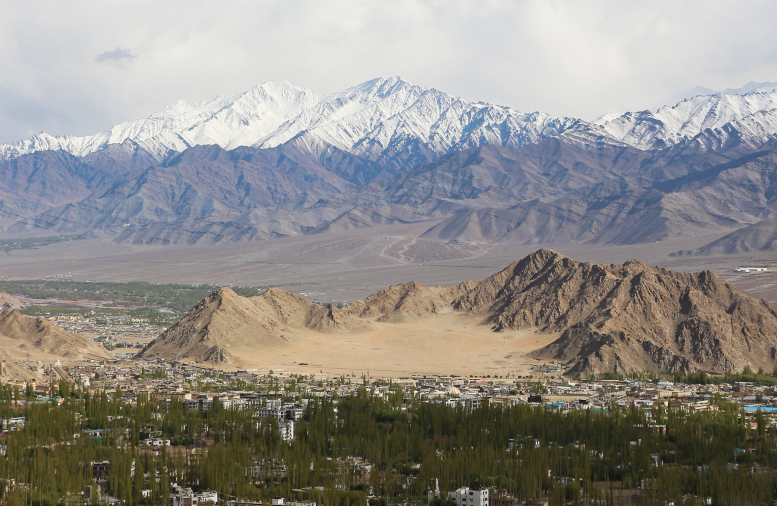
Ladakh – A Region at a Crossroads
In recent years, Ladakh, a trans-Himalayan region in the northern part of India, located between Tibet and Kashmir, has often made national and international headlines. Ladakhis have long been vocal regarding their demands for autonomy using relevant provisions of the Constitution of India, with full democratic rights. This is owing to Ladakh’s unique socio-ecological setting. 97% of Ladakhis are recognised as ‘Scheduled Tribes’ (equivalent to indigenous peoples, though this term is not accepted by the Government of India), who have long struggled with the imposition of other languages, culture and developmental decisions made regarding them and their lands, without the right to participate and be fully represented in the decision-making process.1
Externally made developmental decisions have been detrimental for the complex socio-ecological fabric of Ladakh. Not only has this led to a loss of local and indigenous knowledge of how to live sustainably in a challenging landscape, the recent unchecked flux of tourists to Ladakh has brought several problems, including water stress, garbage, road construction and vehicular traffic. It is with this in mind that Ladakhis are demanding, under India’s constitutional framework, the implementation of the Sixth Schedule. This framework grants governance powers, land use rights, and cultural protections to indigenous regions in India. Furthermore, Ladakh seeks full statehood, with its own elected legislature and the realization of full democracy. These measures would empower Ladakhis to steward their land, water and air, anchoring development in local priorities rather than external extractive agendas.
But what does energy transition have to do with this? Ladakh’s call for autonomy intersects with multiple central government announcements with regards to making Ladakh “climate neutral”. At one level, this ignores the fact that Ladakh has probably always been ‘climate-negative’, in that emissions from its local livelihoods and lifestyles have most likely never exceeded the carbon absorption capacity of its vast landscape. More importantly, though, this announcement entails, among other things, opening the region to large scale solar, wind and geothermal projects as well as critical mineral explorations. This also includes constructing a 900 km long evacuation infrastructure that will transmit most of this energy to high-consumption centers in India. While Ladakhis support a transition to renewable energy and have indeed been pioneers in implementing and democratically running several off-grid solar systems, this top down imposition of mega projects at the cost of local needs, like obstructing the land for pastoral communities, has raised concern. Autonomy would allow locally elected representatives to be active partners in steering these decisions regarding renewable energy infrastructures and the Sixth Schedule would protect the needs and demands of the local pastoralists as well as the local ecology.
In this article, we discuss how two diametrically opposed visions of the energy transition are clashing in Ladakh. On the one side, stands a grassroots movement championing low-impact, locally-generated energy and ecological stewardship, exercised within the framework of constitutional autonomy. On the other side, is a central government-backed strategy aiming to unlock Ladakh’s resources—solar farms, geothermal and critical mineral mining—to power distant energy needs. We argue that this clash is much more than technological; it is a foundational dispute over autonomy, governance, justice, and what kind of future Ladakh wants.

Alchi village, Ladakh – ideal landscapes for decentralised energy democracy @ Ashish Kothari
Local Ecology, Autonomy and Techno-Extraction
Ladakhis have long practiced “pluriversal” energy stewardship. This includes, in the traditional sectors, wise use of solar radiation for agriculture, in housing / architecture, and other ways. In the modern sectors, this is rooted in locally adapted, low-impact technologies like passive solar heating, small-scale solar installations, solar-greenhouses and solar pumps. These systems tap into the sun’s bounty while being ecologically sensitive and socially responsible. They exemplify a model of energy transition that is decentralized, democratically governed, and attuned to environmental stewardship. These grassroots initiatives transcend mere technical fixes: they are embedded within a worldview where land, water, sunlight, and climate are interwoven with cultural identities and socio-ecological balance. Termed a “pluriverse,” this perspective upholds diverse ontologies and practices—standing in contrast to universalizing, one-size-fits-all technocratic schemes.

Passive and active solar systems at the Himalayan Institute of Alternative, Ladakh @ Ashish Kothari
In contrast, the Indian central government is promoting large-scale “renewable” energy projects—vast solar parks, geothermal installations, green hydrogen development, and extraction of critical minerals. The 2023 national budget allocated Rs 8,300 crore (approximately USD 994.17 million) for a 13-GW solar and wind energy project in Ladakh. Designed to transmit energy out of the region via a 900-km-long intra-state transmission line, the initiative has been praised across the country as a symbol of India’s dedication to energy transition. However, environmental and livelihood rights advocates—both within and outside Ladakh—have raised serious concerns about the project’s location in the ecologically sensitive Changthang area. The proposed solar farm is expected to encroach on traditional grazing lands, disrupt wildlife habitats, and place additional strain on local water sources. Compounding these issues is the lack of consultation with affected communities and their elected representatives, which has triggered protests and growing resistance. The development of massive solar parks like the one planned in Pang starkly contrasts with Ladakh’s historically community-centered, small-scale approach to solar energy. The region’s limited constitutional autonomy, absence of environmental protections, and lack of statehood further constrain local resistance to such large-scale interventions.
Massive renewable energy parks, like the one planned in Changthang, are designed to feed energy consumption far beyond Ladakh’s borders, into India’s booming urban centers . While publicised under the banner of carbon neutrality, this techno-centric model often sidelines local voices, envisions Ladakh as a resource periphery, and situates the region as a “sacrifice zone.” This constitutes a form of green colonialism—extracting environmental capital from vulnerable landscapes under the green banner, obscuring local socioecological consequences. Without local consent or control, such initiatives can disrupt grazing lands, wildlife habitats, water systems—and local ways of living conceived in coexistence with Ladakh’s complex ecosystems.
The Heart of the Matter: Autonomy & Democratic Governance
At the core of this dichotomy lies the question: Who gets to decide? Currently designated a Union Territory (a status it got in 2019, when the Indian government removed the special Constitutional status of Jammu and Kashmir state, within which Ladakh was a district), Ladakh falls under direct central government authority—a setup that severely limits local democratic governance and participation. However, the demands for a genuine democracy, centered on constitutional and political reform, are getting louder. Proposed pathways to autonomy include bringing Ladakh under India’s Sixth Schedule, a framework granting governance powers, land use rights, and cultural protections to tribal regions in North-East India. Another demand seeks full statehood, with its own elected legislature. These measures would empower Ladakhis to steward their lands, define energy directions, and preserve their heritage—anchoring development (or rather, well-being) in local priorities rather than external agendas.
Since early 2023, Ladakh has witnessed waves of protests led by grassroots organizations such as the Leh Apex Body and Kargil Democratic Alliance, alongside voices like local educator and climate activist Sonam Wangchuk . These movements assert that autonomy is essential to resisting top-down extractive projects and to protecting pre-existing, functional low-impact energy systems. These acts of resistance are not just as opposition, but a defense of a living ecological and cultural landscape—a landscape that is threatened by external, top-down interventions.
Pluriversal Technologies & Radical Ecological Democracies
In Ladakh, community-designed structures like solar-earth homes—using earth sheltering and thermal mass—regulate indoor temperatures naturally. Meanwhile, solar greenhouses have extended the growing season for leafy greens and vegetables, an essential lifeline for food security during harsh winters. These systems are rooted in local agency: built, owned, and maintained by communities and small institutions. Decision-making is not outsourced to distant corporations or governments, but arises from solidarity, indigenous knowledge, and shared visions of living lightly and justly on the land. Together, they represent not just renewable innovation—but an alternative “eco-swaraj” or radical ecological democracy—where energy is inseparable from place, ecology, and community ethics.
We argue that without constitutional autonomy, Ladakh’s socio-ecological integrity stands at risk. Autonomy empowers communities to decide which technologies are permissible, which ecosystems to protect, and which forms of energy are appropriate. It breaks the narrative of Ladakh as a passive supply zone for remote energy demands. Moreover, autonomy fosters a pluriversal imaginary—a political terrain where diverse pathways are recognized, protected, and celebrated. It combats the homogenizing pressures of centralized, profit-driven systems—echoing calls for a broader world beyond extractivist models.
Negotiating Futures
It is important to acknowledge that among Ladakhis, visions of prosperity aren’t monolithic. The community faces internal dialogue: between material progress and ecological restraint, between aspirations fuelled by modern conveniences and the desire to preserve cultural integrity. This is not merely a technical challenge—it is a philosophical and ethical crossroads: which forms of prosperity should guide this high-altitude cold-desert society into the future? We suggest that navigating these questions requires local democracy—open spaces for debate, shared reflection, and collective decision-making under autonomy – as a necessary, if not sufficient, condition.
Ladakh’s story echoes a global pattern: the tension between centralized “renewable energy” projects and ecological justice. Across the Andes, Africa, Southeast Asia, similar scenarios are emerging: mega-solar farms, battery mines, wind turbines crowding territories where indigenous peoples and other local communities have historically practiced sustainable living. Ladakh’s pluriversal model inspires us to ask a) What if energy systems were local, community-run, culturally grounded, i.e. a vision of energy sovereignty? and b) How might autonomy and democracy shape just energy landscapes everywhere? The struggle for autonomy and pluriversal energy futures in Ladakh is at once a cautionary tale and a source of radical hope. It calls on us to reimagine energy transitions—not merely as shifts in infrastructure, but as transformations in governance and worldviews regarding energy. However, Ladakh stands at a crossroad: will it be subsumed into distant grids and profit-driven systems, or will it reassert its autonomy and ecological wisdom? The stakes extend far beyond regional borders. In those sun-drenched valleys live experiments in self-governance, ecological balance, and deeply democratic energy practices. These models don’t reject technology—but insist technology be rooted in place, ethics, and community.
If India—and the world—watches closely, Ladakh may illuminate a way forward for climate action that’s not just clean, but just and plural. When autonomy meets ecology, a pluriverse of possibilities emerge—not imposed, but chosen; not based on extracted, but socioecological flourishing.
1)This piece is based on an original research article by the authors that can be accessed here: https://doi.org/10.1177/19427786241303762