
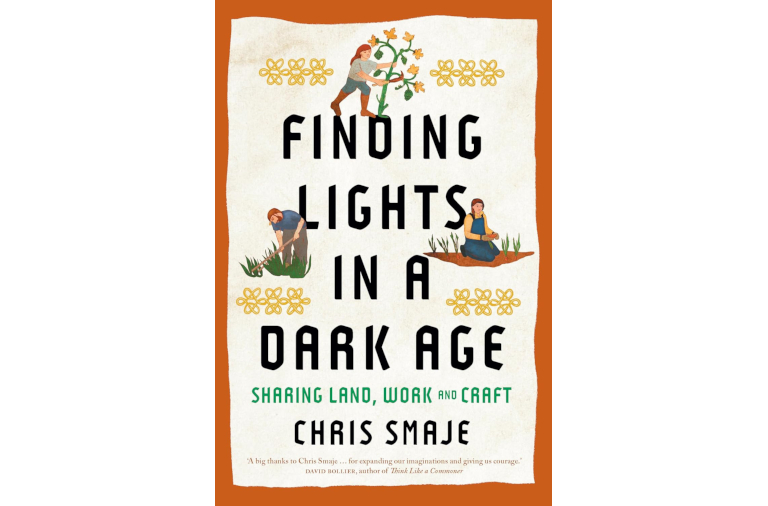
 The following is an excerpt from Chris Smaje’s new book Finding Lights in a Dark Age: Sharing Land, Work and Craft (£19.95 Chelsea Green, UK release 14th October 2025) and is printed with permission from the publisher. The book will be released in the U.S. on November 11.
Open Country
But it would be wrong to overemphasize ruralism. What matters above all is that people get occupancy rights that give them the long-term residential security to address their livelihood needs, and it’s entirely possible that these will sometimes be obtained in urban or suburban situations.
Crops can be grown in gardens, up walls, on rooftops and in parks and other community spaces. Water can be collected and purified. Pigs and hens can be kept by households or neighbourhood groups in small lots and fed on wastes and byproducts to provide much needed fat and animal fibres. Even ruminants can be grazed rotationally around city lots, like the Street Goat project in Bristol, near to my home – or like the mixed agricultures that goon in a many a Global South city with less fastidious separations of the urban and the agrarian than is typical of wealthy countries. David Holmgren’s Retrosuburbia provides endless inspiration for making small, built spaces productive of the necessities for life. Ted Trainer’s small-town ‘simpler way’ philosophy is another source of inspiration. Part of my arc of future Earth projection in the introduction suggested such possibilities. To frame it in terms of modern aestheticized lifestyle terminology, solar punk futures are possible.
Still, the present density of urban residence challenges the notion that urban people at existing population levels will be able to meet their needs feasibly from available resources long-term. Advocates of mass urbanism need to provide brass-tacks answers to how the periphery-to-centre pipeline I mentioned in chapter 1 will be sustained in situations of lower energy and lower political order. Where will the food, water and energy come from? Where will the wastes go? At whose expense? My argument is not an anti-urban one so much as a pro-reality one. As William Rees bluntly puts it, ‘What the mainstream refuses to acknowledge is that the dance between energy supply and overshoot (or climate change) poses an unprecedented challenge to the very existence of contemporary urban society, particularly large cities and mega-cities.’
So, greater ruralism beckons. Time for cottagecore to brush up its soft-focus image, toughen up and give solar punk a run for its money?
It seems inevitable that the future will be more rural than the present, either from people voting with their feet and leaving challenging urban areas or, longer term, from greater population growth in favoured rural areas. Or both. Indeed, this could prove a relatively slow, cross-generational shift – in the US, for example, from increasingly unfavourable places like Los Angeles and the Southwest generally, to more favourable ones like New England and parts of the Midwest.
There will certainly be nodes of concentration and urbanism within those larger geographic shifts. But the balance of relative urbanism and ruralism will depend on a lot of factors around state power, energy, exchange and political economy that are currently uncertain. What people living across the urban-rural spectrum of settlement density consider they owe to one other or expect from one other, and what factors hold them to that settlement pattern, raise important questions, some of which I discuss in later chapters.
Still, more important than the exact patterning across the urban-rural spectrum is the fact that people will favour areas where they can best secure occupancy rights for viable local livelihoods – what I propose to call ‘open country’. Open country may be urban or suburban, while many rural areas may not be open country – Monbiot is surely right that a warm rural welcome won’t be universal. In some cases, newcomers might find ways of making rural areas more open (see pages 113–14). In the long run, it seems clear that the urban-rural balance will tip toward the latter from its present extreme and fossil-fuel enabled disequilibrium, but the way to that destination could be crooked.
This brings us back to my story in chapter 2 about our campsite. Will it be open country here, where I live? Will people arriving here from harder situations elsewhere, possibly with few other options, be able to secure occupancy easily or not? Or will we who now live here find ourselves seeking open country elsewhere? Where, generally, will the refugia in the future be, and why will they be in those specific locations?
It’s impossible to know what the answers to these questions will be in detail, but it’s useful to ponder them in general. This draws us into probing a little deeper into what makes for open and closed country.