
For Oxana Timofeeva, the soul serves as a speculative concept for us to understand our current environmental catastrophe. The soul is neither the inner self, the divine, nor the immaterial, as traditional philosophical thinking might argue. Rather, it is that which binds us together: it is relational and environmental, and when a species goes extinct, its soul, and thereby its relations, goes with it.
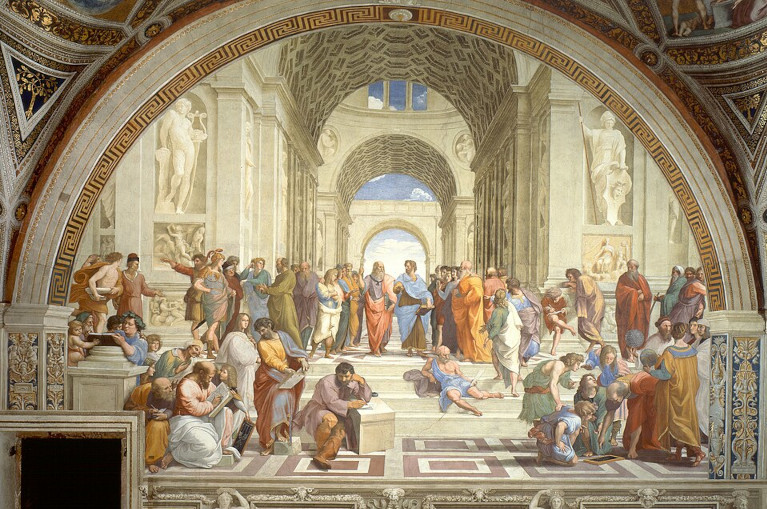
I met philosopher Oxana Timofeeva at the Center for Applied Ecological Thinking where she is a visiting professor. She has been invited to the Center because of her longstanding authorship on the question around the human and the non-human distinction. She continues this pursuit in her forthcoming book, On the Soul, where she finds herself re-enchanted by Plato, a thought figure she otherwise has struggled to incorporate into her thinking due to his patriarchal and eurocentric connotations. Indeed, Plato is associated with Western metaphysics that historically has privileged humans above all other beings, knowledge over nature and mind over body, and finally an immaterial world of ideas over the physical world. In this hierarchical framework, we also find a taxonomy of intellectual capacities where thinking and writing belong to humans alone: man is superior, and his body is but a vessel to reach the world of ideas by his ability to think. “But if you look closer at Plato’s work”, says Timofeeva, “he speaks to desires, drives and the unconscious — like an early iteration of psychoanalysis.” Human beings are much more than their ability to think and produce knowledge. She argues that by reexamining an old philosophical term — the soul— from the perspective of literature from the 20th and 21st centuries, Plato can bring us closer to understanding the depth of the environmental crisis.
The soul is Timofeeva’s speculative concept that she uses to understand the current environmental catastrophe. She draws on a long list of classical and contemporary thinkers in this pursuit: Bruno Latour, Donna Haraway, Jakob von Uexküell, Friedrich Schelling, Plato and Aristotle, to name a few. At the core of her thinking is the exploration of fundamental boundaries: what is alive and what is dead, what is human and what is non-human, and what is individual and what is collective. The soul is that thing which is in-between. Perhaps not unlike the romantic tradition, the soul permeates and connects everything.
Although Timofeeva initially hesitates when asked for examples of the soul, she points to her laptop and says, the hardware is the body, the software is the mind, and electricity makes them work together. Electricity is that in-between thing. Another example she offers is oil: whether buried under layers of permafrost in Siberia or in the deep ocean, this highly explosive substance binds together layers of time and material. “Oil is the in-between,” she says. Through these examples, Timofeeva illustrates how the soul is inherently collective and transgresses the limitations of the individual self.
Why is this significant? In a traditional interpretation, the soul is perceived to be divine and immaterial. Or, it is understood as something within the human body that relates to a deeper inner self. But this is not what Timofeeva wishes to convey. In her more environmental reading, she asserts the soul not as self or god but as relation. The soul describes relationships to nature and life. She draws on Jakob von Uexküll’s concept of the umwelt, which refers to the perception of the world of a living thing: the animal experiences itself as a self and nature itself becomes a subject. Each species contains a world and perspective within itself. All humans and non-humans have a soul that is interconnected — a complete set of relations and a unique environment that is theirs. Timofeeva explains that the soul helps us dissolve the clear-cut distinction between human and non-human. Because the soul exists in between each umwelt, the ontological meaning of extinction is terrifying: extinction means not only the death of the species but also the death of the world that the species inhabited. The loss of species is therefore the loss of the souls, a unique perspective, and a relationship with an environment.
Timofeeva returned to Plato because she wanted to counter a materialist perspective by activating a more expansive understanding of what life encompasses. In western tradition, we understand the body to be mortal. It can die and decompose. The soul, however, is perceived to be immune to death and destruction. But this is a simplistic dichotomy, she argues: the soul is not immaterial or rooted in the individual, but collective, relational and environmental.
When I ask Timofeeva about her political motivation, she answers promptly: she sees her role as the one who formulates questions, not the answers and solutions. Once the questions are asked, normative ways of thinking that feed into violent cycles can be broken. By conceptualising the soul, she gets closer to exposing a truth that we take for granted; that humans are above non-humans, that the death of a species is the death of an environment. What is considered commonsensical can be challenged, and from there, change can happen. Understanding the depth and gravity of what is lost will, hopefully, inspire commitment to change.
In Plato’s thinking, all souls live, then transmigrate to the underworld before being reincarnated. This metamorphosis and cycle is what makes up the world: all species contribute to each other in a multiverse of perspectives. The soul is a relationship between the living and the environment—and it is that which is lost by extinction.
This article is part of a series published by the Center for Applied Ecological Thinking at the University of Copenhagen. It is a write-up about the event, ‘Soul and Environment: Psycho-anthropology of the Nonhuman Worlds‘, (March 27, 2025).