
The toxic debris and sickness that the Allied Forces called upon to destroy Hiroshima and Nagasaki in 1945 had been impacting miners in the Belgian Congo for decades prior to World War II and continued to do so long after the end of the war. In artist Toshie Takeuchi’s work, she travels from Belgian archives to Congolese mines to expose the long durée trail of destruction that the powerful uranium leaves behind in the imperial — British, American, French, Belgian, German — drive for wealth and power.
We know the atomic bombing of Hiroshima and Nagasaki as the horrifying American full stop that ended World War II. Haunting photographs from the two Japanese cities remind us of the civilian loss and suffering that continued for generations due to radioactive exposure. It is a war that continues to receive great attention in Western historiography, but not only with the purpose of uncovering devastating costs: extreme violence is understood to be an exception that offers an introspective lens with which empires — British, American, French, Belgian, German, Japanese — continuously can redeem themselves.
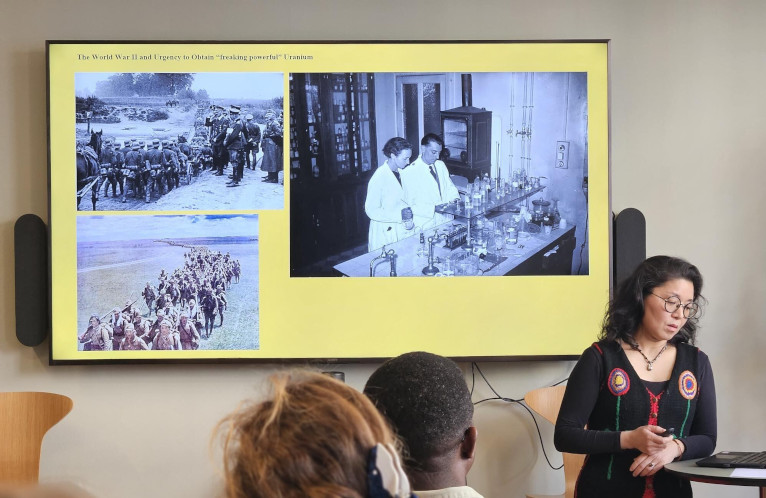
Takeuchi has been invited to the Center for Applied Ecological Thinking at Copenhagen University to share insights from her artistic research alongside her colleague Professor Edouard Ilunga wa Ilunga at Lubumbashi University. While her starting point is World War II, it is not another redemptive story that Takeuchi wants to uphold in her artistic practice. In fact, she critically exposes how the Japanese Empire used its victimhood to obscure its brutal invasion of Southeast Asia. Not to mention the significant numbers of Korean survivors who struggled to access adequate medical care due to the colonial relationship between Korea and Japan. Through this lens, Takeuchi insists on asking, what does a decentralised narrative of World War II allow us to understand about the imperial drive for wealth and power? She turns to uranium, the radioactive ingredient of the Hiroshima nuclear bomb, to reveal the fantasy that upkeeps violence as an occasional and necessary exception instead of the point of reference. In a world history where victims and heroes are fabricated, simplified characters that serve imperial preservation, uranium and its site of extraction speak truth to imperial power.
Takeuchi uncovers the journey that she embarked to complete her collaborative work “Refuturing the Soil 2. – Mapping the other side of modernity and peace, guided by the radioactivity of Shinkolobwe’s uranium ore –” (2024), a collage of post card-shaped photographs, some archival and some her own. The work formed part of the exhibition “Shinkolobwe Between Power and Memory” and was produced at the Lubumbashi Biennale 2024 with artists Roger Peet and Sixte Kakinda. Takeuchi’s quest takes her to the Shinkolobwe mine, a now closed facility that is situated in Katanga, the region in the Democratic Republic of Congo that holds the world’s richest ores of copper, cobalt and uranium.
It is in Congo that her work flows together with her colleague Professor Ilunga wa Ilunga whose work revolves around metallophytes — plants that thrive in rich mineral soil. Historically, plants have been used by locals to identify mineral deposits, as they mirror the layers of richness the soil holds. A trained eye can spot copper malachites in the hilly landscape of Katanga, says Professor Ilunga wa Ilunga. The local use of minerals has been an integral part of the Central African regional trade systems, where ingots were once used as currency. But it was after a British geologist detected radioactive material that a company under the Belgian kingdom began large-scale drilling in the Shinkolobwe mine for radioactive minerals in 1921. Local miners worked with their bare hands and lived in segregated houses most likely built of radioactive waste. Occupational diseases related to radioactive material had already been identified in the 1920s in the American lawsuit filed by the so-called “Radium Girls” who were dial painters for clock manufacturers. The connection between radon, radioactivity and cancer had also been discovered and published in The American Journal of Cancer in 1923. However, in the Belgian Congo, safety precautions and medical knowledge were ignored and the Belgian company Union Minière du Haut- Katanga continued without protection, Takeuchi explains.
While the company had sold uranium to Europe towards the development of nuclear weapons, this export business became complicated when Nazi Germany invaded France, says Takeuchi. Union Minière du Haut-Katanga decided to ship 12 tons of uranium to New York to prevent their uranium stock from being hijacked. The corporation’s profit on the mining industry culminated with the US monopoly on Congolese uranium, a secret in the supposed free market. The efforts of hiding the uranium ore went so far that Winston Churchill, in a speech, thanked Canada for its uranium contribution as a distraction from Congo being the actual point of extraction.

As Takeuchi follows the trails of uranium contamination, she finds herself in the natural history museums of the Belgium kingdom where specimens of highly radioactive uranium used to be on display in glass vitrines. Such collections, alongside world expositions such as the Brussels World’s Fair in 1958, showcased the newest technologies of mining and trophies from the colonies. Uranium was exhibited alongside colonial subjects — human beings — from Belgian Congo and sculptures of strong, healthy bodies working in mines. But this artistic rendition of mining labor was far from the truth advanced by the dehumanising display: Takeuchi noticed in archival photos that mining workers also included children. Professor Ilunga wa Ilunga adds: to this day, 40.000 child workers continue to work with highly hazardous material to supply the corporate demand for cobalt and copper.
In Lubumbashi, where Professor Ilunga wa Ilunga works, the natural history collection has become a reflection of the outside nature that once flourished but that now no longer is. He tells stories about specimens of endemic copper flowers that he has only seen in herbaria. His conservation work mostly consists of bringing endangered specimens to a micro reserve from the mining site where the ecosystems are disturbed. Staff is low in botanical gardens and the shifting owners of mining companies make it hard to upkeep long-term preservation projects. After all, it is a politically sensitive endeavor for companies whose existence and profit are dependent on disrupting metallophytes.
Professor Ilunga wa Ilunga speaks to the troubles of his discipline: once botanists served as pawns of the empire who explored colonised land to identify potential ores. Today, opportunities for restoration practices are systematically prevented: when a site finally has recovered and gained plant diversity after the closure of a mine, new technologies are developed that allow what was once considered waste to be new potential for mining and the mine is reopened. In this way, his primary task is to work with local communities who coexist with extreme levels of toxic pollution and prepare for a life after mining companies leave large amounts of waste.
The uranium mine of Shinkolobwe rejects the simplified narratives of victimhood, heroism and exceptionalism that are told about the winners and losers of World War II. Takeuchi and Professor Ilunga wa Ilunga bring attention to the toxic debris, sickness and destruction that uranium extraction caused not only in Hiroshima in 1945 but for decades prior and after in Congo. Imperial desires for power and profit continue to drive the extraction of uranium that once devastated Hiroshima and its inhabitants and that continues to harm the workers and civilians living around and sustaining life in uranium extraction sites in Katanga. Only when a mining site is completely exhausted can restoration begin, Professor Ilunga wa Ilunga says, because then nobody will return to the soil and disturb potential plant life — neither mining companies nor local communities who hope to scrape the last bits of minerals from the already discarded industrial waste. But if all minerals are extracted from the soil, will the flowers ever bloom again?
This article is part of a series published by the Center for Applied Ecological Thinking at the University of Copenhagen. It is a write-up about the event, “Restoring Global Memories & Local Ecologies: Metallophyte plants and colonial history in DR Congo mining” (March 6, 2025) where artist Toshie Takeuchi and Professor of Botany Edouard Ilunga wa Ilunga presented their work alongside Associate Professor Martha Fleming, Center for Practice-based Art Studies, who moderated a panel discussion and who leads the project “Field/Work in the Archive: Herbaria as Sites of Cultural Exchange” at the Danish National Herbarium at the Natural History Museum of Denmark.