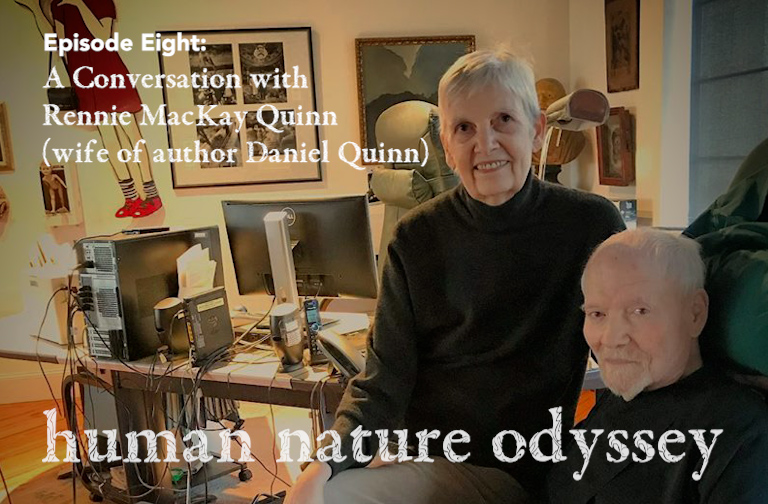
In this very special episode, author Daniel Quinn’s wife Rennie Mackay Quinn joins us for her first ever interview: sharing untold stories, new insights, and reflections on her life and journey with her beloved late husband Daniel Quinn.
Rennie tells us about the 15 years it took Daniel to write Ishmael, the childhood dream that sparked it, how the word “hamburger” changed their lives, how they navigated the response and acclaim to Ishmael, and much more.
Credits
Theme Music is “Celestial Soda Pop” (Amazon, iTunes, Spotify) by Ray Lynch, from the album: Deep Breakfast. Courtesy Ray Lynch Productions (C)(P) 1984/BMI. All rights reserved.
Image: Photo of Rennie MacKay Quinn and Daniel Quinn, via Ishmael.org; used with permission.
Join storyteller Alex Leff, creator of the podcast Human Nature Odyssey, on a search for better ways to understand and more clearly experience the incredible, terrifying, and ridiculous world we live in.
Related Articles
'SELECT SQL_CALC_FOUND_ROWS wp_posts.ID
FROM wp_posts LEFT JOIN wp_term_relationships ON (wp_posts.ID = wp_term_relationships.object_id)
WHERE 1=1 AND wp_posts.ID NOT IN (3507735) AND (
wp_term_relationships.term_taxonomy_id IN (5,46432,47210,47212,47214,47441,47485,47486,47503)
) AND wp_posts.post_type = \'post\' AND ((wp_posts.post_status = \'publish\'))
GROUP BY wp_posts.ID
ORDER BY wp_posts.post_date DESC
LIMIT 0, 3'
What does a livable future look like 100 years from now? If we unlocked unlimited green energy, what would we actually do with it? And are our dreams of a renewable-energy utopia sometimes just as delusional as the fossil-fueled ‘drill baby drill’ mentality?
I do think we need this feast to return to its roots, as a potlatch, a bonding redistribution of wealth and full bellies, a rapprochement across the great divides, and a coming together in joy to feed each other. We need something that draws us into community, that builds ties, that creates relationship and memories.
Rather than being a religion, animism is a mindset that had common purchase around the globe prior to modern times. Not only is it important to appreciate how we used to be when the planet’s ecological relationships were more “normal,” but it offers a worthy alternative to dualism that has much overlap with an astrophysical perspective.