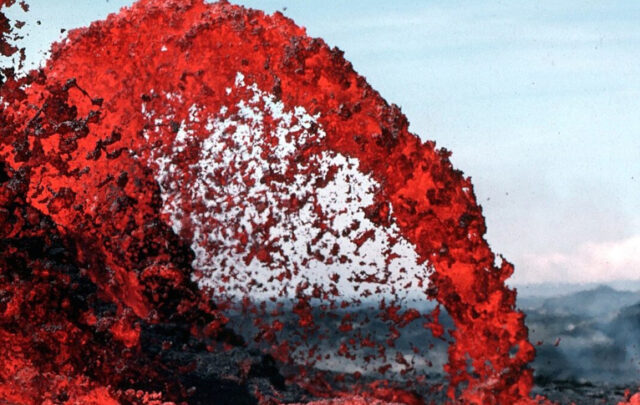


I live in a forest under the peak of what is perhaps the world’s most active volcano, Kilauea, in remote Hawai’i during most of the year. My gaze lifts from the surrounding Pacific Ocean to various tall volcanic summits on the Big Island, especially Mauna Kea and Mauna Loa. I draw the attention of my Communication students to these peaks. These are real peaks that can be seen, not metaphoric peaks that can only be imagined, or drawn on a piece of paper or demonstrated on a graph or power point presentation by a science-based explantion of Peak Oil.
Peak Oil began as a descriptive scientific concept. It has also evolved recently to become an evocative metaphor. Some use the term for its purely geological meaning, whereas others use it to imply a larger picture that it has come to suggest. These two uses – scientific and metaphoric – can sometimes differ and be confusing. Use of what seems to be a simple term has become complicated.
In the l950s Shell Oil Company geologist M. King Hubbert predicted that America’s petroleum supply would soon peak and gradually decline. His concept was mathematically developed, based on empirical evidence, technical and rather narrow. Though other geologists were skeptical, Hubbert was proven correct when America’s oil supply did peak in the early l970s. In typical scientific fashion, this phenomenon became known as Hubbert’s Peak. His students and others–such as now retired Princeton University geologist Kenneth Deffeyes–continued his scientific work to establish his theory. Peak Oil is being increasingly accepted within the oil industry, by the media and the public, though the term itself is not always used.
Peak Oil is also a metaphor that can help connect the following and other dots: Iraq War, America’s decline/China’s emergence, renewable energy, climate change, rising gasoline prices, hybrid cars, threats against Venezuelan president Hugo Chavez, Wal-Mart’s slump, re-localization, rising gas station violence, airline bankruptcies, survival, mass transit, sustainability, etc.
Peak Oil is an underlying reality that can be used as a key to open doors to understand what is happening locally and globally. It provides context and offers an analytical and synthesizing tool to describe a bigger picture. It could be considered shorthand or a stepping stone to a larger reality.
Peak Oil has a better ring to it than oil peak. Peaking Oil might be more accurate, but it does not have the satisfying ring to it that Peak Oil does, which can help to mobilize people. Other useful terms being used as synonyms include energy descent, oil decline, the end of cheap oil, the party’s over, and the twilight of oil. These terms are helpful, but they do not have the historical weight and gravitas of Peak Oil. The term is growing beyond its narrow denotative meaning to have a wider connotative meaning.
By capitalizing the concept, one indicates the fact that it is not merely a casual association of words, but the naming of a phenomenon. Though technically a noun, Peak Oil is like a verb, since it is an unfolding process, rather than an event.
Peak Oil implies related terms such as Beyond Oil and Post-Carbon Society, which various groups have used to name themselves. It piques curiosity, can open conversations, and draw people into community. Peak Oil is an organizing tool to help bring people together to deal with its consequences. When people push through their initial denial, they then often deal with anger, fear and grief, before getting to acceptance. If one sits at home alone in the face of Peak Oil, isolation and getting stuck in fear, anger, or grief are more likely to occur. Small neighborhood-based groups can talk openly about Peak Oil, their feelings, and develop solidarity. In such groups one can learn the skills and capacities to survive in a Post-Carbon world.
Peak Oil is a bipartisan term used by people such as Houston-based energy investment banker Matt Simmons, an advisor on energy policy to the 2000 presidential campaign of George W. Bush, Republican Congressperson Roscoe Bartlett, and oil baron T. Boone Pickens. Progressive/prophetic writers such as Richard Heinberg, James Howard Kunstler, and Matt Savinar have popularized it in recent years. Peak Oil is different things to different people, as a good metaphor can be. Peak Oil is many things, among them a geological limit and part of a New Story-which physicist Brian Swimm describes–that is emerging here at this beginning of the 21st century.
Climb the volcanic peak with us, be thankful for the Black Gold provided us, enjoy the remaining days of oil, and then a slow ride down the mountain, however bumpy and many decades that may take.
(Shepherd Bliss, [email protected], divides his time between teaching college in Hawai’i and Sonoma County, Northern California, where he owns Kokopelli Farm. This article may be reprinted, as long as it is printed in full and attribution to both author and original publication are given. For permission, contact [email protected].)