

Why is it so difficult to find a job or to buy products that align with our values? Why is it difficult to even know whether our personal choices might have effects in the right direction?
In Alyssa Battistoni’s view, the separation of our intentions from the effects of our choices is a core feature of capitalism.
In this second post on Battistoni’s book Free Gifts: Capitalism and the Politics of Nature, we’ll look at what she identifies as one of the two key social relationships in capitalism: market rule. (Spoiler: the other key social relationship, class rule, is a major focus of the next post in this series.) In exploring market rule, Battistoni draws on insights from existentialist philosopher Jean-Paul Sartre to extend older concepts of alienation.
Nearly every person alive is dependent on the market for some of the necessities of life at some point. For many of us that dependence approaches totality. Almost every morsel of food we eat, and every bit of clothing we wear, gets to us through market mechanisms. Our homes, our educations, our health care, our transportation, day care for our children – these are generally controlled to a lesser or (usually) greater degree by market interactions.
And what is the market? It is a system for determining the relative value – the price – of everything that is exchanged.
We each have our own judgments about the worth of a healthy and fresh-picked tomato compared to a handful of heavily seasoned packaged corn chips, or the worth of an hour’s work by a skilled nurse compared to an hour’s work by a skilled advertising copywriter. But our personal, individual judgments of worth are wholly irrelevant in the market.
That’s because the market “simultaneously atomizes and aggregates our decisions in ways that defy both individual and collective control.” (p. 57; all quotes are from Free Gifts unless otherwise noted)
Battistoni adds:
“Crucially, our motives have no bearing on these outcomes: markets are indifferent to our purposes, seeing only prices. In other words, they detach intentions from consequences.” (p. 62)
If I enter a store looking for a pair of jeans, I may or may not care whether the people who pick the cotton, spin the cotton, design the jeans, sew the jeans, ship the jeans, market the jeans, or sell me the jeans are fairly paid. And the market doesn’t care whether I care. What counts is whether or not I hand over my money for a pair of jeans, at a price set through a vast chain of other exchanges.1
It is difficult ranging toward impossible for me to know whether the other people in that chain of exchanges are fairly paid, let alone for me to influence their pay scales.
As Battistoni says, in the market “everyone is the abstract other to everyone else.” (p. 69)
Who’s responsible here?
Consider another example. Let’s scramble time, you and I, and go car shopping with Karl Marx and Jean-Paul Sartre.
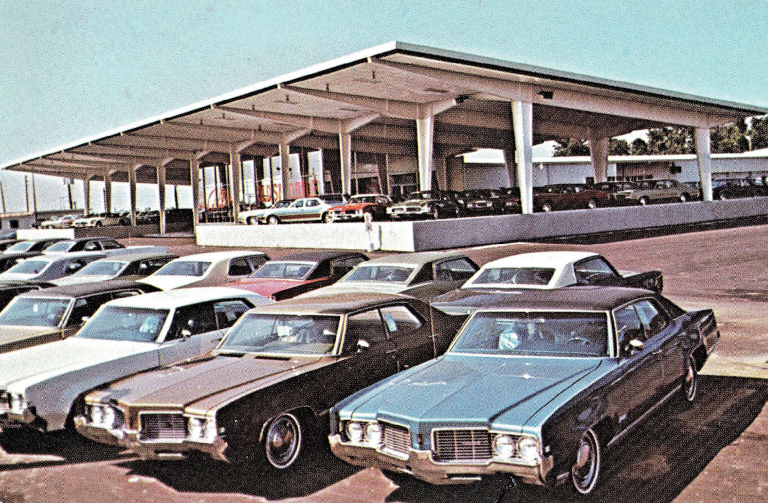
As we enter a North American dealership, we see that most of the vehicles on offer are huge – even bigger than the last time we went car shopping together. Most of the vehicles are SUVs and pickup trucks, and the current models are longer, heavier, and higher than corresponding models a decade or two ago.
Is this because most of our fellow consumers really value the ability to burn a lot of gas and emit the maximum amount of CO2? Do we each want to have the largest possible blind spots in front of the towering front ends of our personal passenger vehicles? Are we each keen to have a “best-in-class” ability to kill pedestrians if we run them down, or to inflict great danger to the occupants of the smaller cars on the road?
Not likely. We may merely be fashion-sensitive, eager to buy something that other buyers, clearly, think is an impressive car. We may not actually want a car at all – but we live in places where nearly every workplace, school or supermarket is hard to reach without a car. We might prefer a smaller, more economical car, but we fear we will be unsafe in a small car surrounded by much bigger cars.
These intentions don’t matter to the market. What matters is whether, in the end, we exchange our money for a set of keys and drive away as new car buyers. And then our act of purchase is just one in millions of data points aggregated by the market to determine price (and price, to the market, equals value).
So you and I, Marx and Sartre pile into our brand new SUV, and once we’ve decided whose phone will sync with the car’s infotainment system we drive away. But clouds of doubt quickly form at the edges of our euphoria.
From the back seat Karl’s voice competes with the GPS navigation prompts: “This is a marvelous product of industrial organization! But have the workers of the world united? Are they now the vanguard of the overthrow of capitalism?”
“Well … sort of … not exactly,” I say. “The workers who put together this car belong to one of the strongest unions. They have organized and fought and gone on strike many times over the years, and they’ve won good pay and even pensions.”
But you point out that most of the parts that went into the car were made in other factories … and the auto companies are building non-union factories wherever they can … and the raw materials were grown or mined or synthesized all over the world. And we have very little idea, really, which of the workers were well paid or which were barely paid at all, or who is living downwind or downriver of the mines and factories, suffering in ill health while we speed down the highway.
We go silent, until the ghost of Jean-Paul deepens our gloom. “I’ve got a bad feeling about this. The four of us all want the world to be a better place, for everybody. But we just spent a lot of money for new wheels, and where is that money going? The fifty thousand dollars we spent might reward somebody who burns down rainforest to plant a rubber plantation. Our money might go to a lobbyist to get environmental regulations scrapped, or ignored. Just a few dollars may make it to kids who are dragging ore out of dangerous tunnels for fourteen hours a day. What are we supposed to do, just stop thinking and get some happy music playing?”
“Yes please!” we say.
“Give it a break already!”
“You’re overthinking things again!”
But that line never seems to work with J-P. So he goes on:
“I just don’t feel free. I should be able to take responsibility for my own decisions. And here I am, with good intentions, but I don’t know if I’m really fucking up the world by spending money this way. And you’re telling me to just stop thinking and listen to chill music? What kind of freedom is that?”
Living in bad faith
Sartre wrote about living in “bad faith” more than eighty years ago,2 and Battistoni sees this as an important concept today. For Sartre true freedom consisted in taking responsibility for one’s own decisions. By contrast, in Battistoni’s phrasing, “Bad faith consists in the denial of our freedom, the disavowal of our responsibility.”
Why is bad faith a “normal” way of life in market-dominated society? Batttistoni writes:
“Under conditions of near-universal market dependence … in which nearly all our decisions are market mediated, nonresponsibility is pervasive – and the freedom that consists in being responsible for our decisions is radically elusive.” (p. 70)
So must we remain in bad faith? Only to the extent that we collude in denying our own freedom. We are in bad faith “when we refuse to countenance the possibility that things could be other than they are, or to examine the choices we make, whether alone or together …” (p 78)
Battistoni emphasizes that bad faith applies to more than individuals:
“Bad faith, crucially, is not only an individual condition. We are collectively in bad faith when we act as if we have no choice but to organize society in the way it is structured at present ….” (p. 79)
And since the market economy structures much of our relationship to the natural world, “we are in bad faith when we treat our socially specific relationships to the nonhuman world as if they were themselves natural.” (p. 79)
Before moving on, it’s important to note that market rule applies at all levels of society. Market rule restricts the possibilities for car buyers, but it also restricts car makers. It applies at the bottom of the socio-economic scale, in the middle, and also at the top.
A high-level auto executive, for example, may wish his company could sell more eco-friendly cars. But that wish will come to nothing if such cars can’t attract enough buyers at sufficiently profitable prices. The executive may wish to offer workers better job security, but he will be ushered out of the C-suite in a hurry if his company’s shares lose value on the stock market. The executive may lament, “the market doesn’t care a whit about my good intentions – so I’m really not responsible for my decisions.” And in simply accepting that “this is just the way things are”, the executive, too, is unfree and living in bad faith.
Footnotes
1 There are exceptions to the rule, which will be part of the discussion about getting beyond “bad faith” later in the series. In that discussion we’ll also bring in concepts from Simone de Beauvoir.
2 In L’Être et le néant, 1943, published in English as Being and Nothingness, 1956.