
Now I am turning to what a post-collapse world will look like. I would recommend that you read the previous five essays (they are all linked in the previous one) in this series to understand where I am coming from. In this essay I discuss energy, capital, technology and work. In the following one I will discuss food and nature and in the final (?) I will turn to the works of human society including markets and trade.
Energy
Most collapse oriented people put energy in general, and fossil fuels in particular, centre stage. I do agree that energy is crucial and I am quite sure that renewables will not offer a seamless transition from fossil fuels. But that doesn’t mean there is nothing in between a fully fossil fuel driven industrial civilization and a 17th century biomass economy. Living in a country with huge wood resources as well as hydro-electricity that was developed already from the end of the 19th century, and where steel production was based on charcoal until the end of the 19th century, I am not convinced that fossil fuels are absolutely essential for anything reminiscent of modern technology.
To begin with, also in the 17th century there were wind and water mills as well as sailing ships, so the framing is not really correct. But the choice is even more flawed as the accumulated infrastructure, materials and knowledge is very different. Even if we had to close down all iron mines and virgin steel mills (making new steel rather than recycling) over a few decades, there is so much steel in circulation that it will supply a global 5 000 dollar per capita economy (which is my starting point for this, see the previous essay) for centuries to come. The same goes for a lot of other “stuff” and infrastructures. In addition, we have much knowledge that was not available in the 17th century. Unfortunately we have also lost some knowledge and skills…
It seems realistic that a post-collapse society first can use much of the existing energy infrastructure that already is there. I expect that nuclear power plants will shut down in any kind of collapse scenario, however. Perhaps there will be societies formed along high-voltage power lines from hydro power dams? Solar panels will continue to work for decades. But soon enough societies will have to reproduce its energy resources, if you can’t do that, they are hardly renewable in the first place.
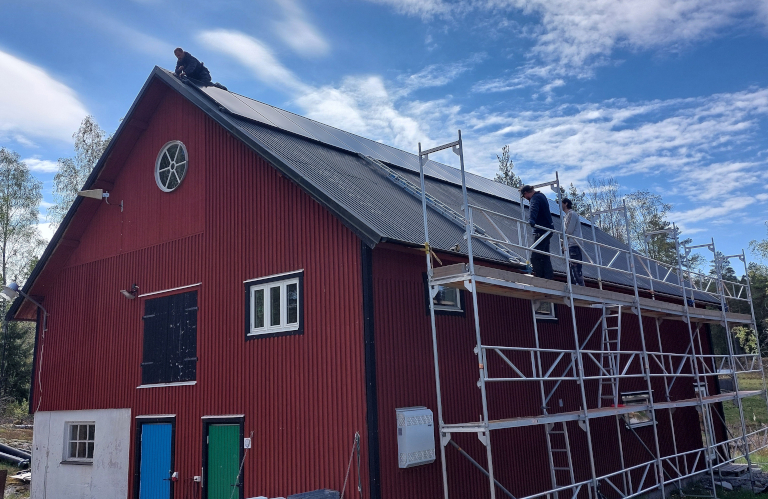
Solar power seems to be a reasonably accessible technology. Of course, on the 60th degree north latitude, where we live, solar is a half year business. When I write this in early November our 11 kW solar panel system has delivered just 1 kWh of electricity for the whole day. On a sunny day in July we get 60 kWh from the same installation. But in many parts of the world, solar could provide quite a decent supply of electricity throughout the year. If you want to run a high tech society with constant reliable uninterrupted supply you need an awful lot of storage capacity though. It is probably a safer strategy to accept interruptions and losses of efficiency rather then spending enormous resources on storage. Our rather costly battery still only stores some 10 kWh (and the off-grid technology we paid for has not worked since the installation four months ago).
A big question, for which I don’t have a good answer, is to what extent photovoltaic electricity is/will be dependent on a enormous technosphere and giant supply lines. “In life cycle analyses of solar panels, scientists calculate how much energy and materials are required to build a solar panel. However, they ignore the massive amount of energy and materials needed to set up and maintain the solar PV supply chain itself” says Kris de Decker of low tech magazine, a person who probably knows the topic well. Could solar panels be made smarter, with locally available materials that can be recycled? If not will supply lines, trade and technology allow for large scale implementation of solar. If so, one can envision that some sunny parts of the world will be more attractive and more developed than my part of the world (which would only be fair, the fortunes of geography are not of our own making).
I am aware of the argument, often voiced by energy collapsniks, that today most solar panels and wind energy equipment are made with massive inputs of fossil fuels, but I see no particular reason for why it would have to be like that. After all, you can make electro-fuels for mining, melting and shipping. For sure, it will be more expensive but it can still be done. The question is really more about how costly it will be and if the cost will be prohibitive.
Similarly, I am not sure how feasible it is for a low tech society to run wind power on an industrial scale. Wind energy is certainly old and fairly simple for low tech applications such as the direct powering of mills or pumps, and one could also generate electricity in quite simple ways. But modern wind power is something quite different. If you haven’t done it, I recommend standing at the base of a 150 meter high wind power pylon and look up as well as down where there is hundreds of tons concrete per pylon (well, you will not see it). A year ago, I went to have a look on the mills in a medium size Swedish wind farm and was stunned by the height and the massive infrastructure needed to put them in place. And the off-shore wind farms are even much more demanding.
When discussing energy, I think it is pertinent to point out that a big share of the current energy use in high-income countries is not for production of anything close to necessities. A quarter of the energy consumed in the EU is used by industries, one third for transport, one fourth in households and the remainder in services etc. Household consumption is a lot about heating and cooling and the rest mainly for the kitchen (cooking, refrigerators, freezers, dishwashing). Of transport a huge share is for private cars or aeroplanes moving people to work, shopping and for holidays. In a more sustainable and resource limited setting most of these transports will simply be gone, either because they are not needed (commuting) or too costly (holidays based on international aviation). Of the services, many are there just for keeping the Machine going. It is estimated that 40% of all shipping by weight is for fossil fuels. In addition, a lot of fossil fuels are used to extract and refine fossil fuels. The net supply of fossil sources energy to productive work is therefore just a fraction of the current consumption. The energy consumption of agriculture is just a few percent of the total energy use in high-income countries (I will explore that in more detail in the next article). That makes the task to replace them less daunting.
Even with rather small energy resources one can run many really labour saving machines. A very small, but essential and with a high reward, share of the energy is used for the heavy work, such as ploughing with a tractor or moving soil or rocks with an excavator, or driving a chain saw. Pumping water for household use or for irrigation of gardens has also a very high utility compared to the energy used. It is probably a bigger issue to make the tractors and the excavators than to keep them with energy, once made. Such a low energy society could be fuelled by a combination of biomass in various forms (biogas, syngas, biodiesel, ethanol, methanol etc.), and solar or wind power. I could even envision a limited use of fossil fuels, where they are available for such use. From a climate perspective the problem is the enormous use of fossil fuels that drives the whole global economy, not a limited use for some special purposes. The trick is more how to ensure that the use doesn’t expand above what is really essential, which is linked to the question about accumulation of capital.
Capital in the 22nd century
In the dominant capitalist civilization, investment in capital is the major driver of economic growth, which in turn results in more capital. We mostly discuss capital in monetary or financial terms, but that conceals the nature of capital, what it really is. Real capital is composed of tangible assets; machines, stocks, buildings, roads etc. Human culture and civilization is basically built around such artefacts and assets. Metal tools and pottery are early examples of essential capital. Work is required to make capital; capital is essentially accumulated work. Some will include other aspects in the term capital; natural, human, social, intellectual. You can do that, but I find that it is not helpful for understanding the nature of the beast, rather the opposite. But some kinds of natural capital have been very important, land and mines for instance. I will come back to the critical question of land in the final essay.
In the modern world, capital is linked to ownership (this is also where the link to money comes in). Note that private ownership of capital has no meaning unless other people respect it. This is most apparent when it comes to pure financial capital. There is no inherent value in US Treasury bonds or in US dollars or Swedish krona. They only have value if somebody is ready to give you something in return; goods, services or their labour. In a post-collapse world most financial capital will be useless or worthless. For real, fixed capital to have economic value two conditions must be met. First, you need to have exclusive access to that capital; that is, it is your exclusive property. The two ways you can ascertain that exclusive access is the recognition by others that it is yours or that you back up you claim with the threat of violence (your own or the violence of the state, the mafia or other violent group), or a combination of both. In the longer term, I would argue that the only safe way for you to keep the capital is if others think that it is fair. Second, there must be some use for that capital in the society you live in. To have a plutonium mine is of little value if there is no use of plutonium, or on a much more simple level: to have a car if there is no petrol is also of very limited value.
But, regardless of the ownership perspective, it is important to keep in mind that accumulation of capital is essential for any kind of technological development of human society. Already a habitable cave with nice wall paintings is a kind of capital formation which can be passed on to coming generations. And capital accumulation is dependent on a surplus of work in society.
How to limit accumulation?
It is a feature of human efficiency that we produce surpluses, we have more energy than we normally need to keep us fed and warm. That surplus energy must be channeled in some way.
Before modernity and capitalism, accumulation of capital over and above what was needed for immediate necessities and basic infrastructure, was rarely a primary interest. Actually, historically, there seems to have been many mechanisms to avoid accumulation or to direct it towards inert objects and arts rather than to productive work. A lot of capital has been used for megalomaniac projects such as Stonehenge, the Pyramids, grand cathedrals and a lot of capital has been sunk in graves all over the globe. Another version, also very common is to destroy surplus energy or capital through carnivals, parties and festivals. Both versions are essentially limiting the build up of capital. One could of course explain this by saying that people didn’t have the scientific or artisan skills to build machinery or factories, but I believe that they, in some way, understood the risks of capital accumulation, or simply that they didn’t see the need, perhaps both. The most apparent method to avoid capital accumulation is obviously to just stop working when you have satisfied the most apparent daily needs, something that also has been practiced both historically and until today.
Apart from limits on societal accumulation, societies have also developed ways to limit private accumulation. This has taken the form of norms of debt relief, modesty and charity as well as potlatches and similar events where wealth was destroyed or shared. To limit private ownership is probably the most effective way to counter private accumulation. When I did a job for the World Bank in Samoa for the commercialization of the vegetable sector I realized that one obstacle for the assignment was the way land was organized. A younger entrepreneurial family I visited said that there was no point for them to invest in irrigation, clearing the land from rocks and increase the production. Because, if they would be successful, the whole village would want to share in the profits made and perhaps the communal land would be re-allocated to someone else. Bad for the World Bank project, bad for ‘development’, but good for social cohesion. There are almost always such trade-offs between efficiency and social and environmental sustainability. On a more superficial level, one can note that the same Westerners that complains about the lack of material development in certain places often express awe over the “relaxed lifestyle” or the “strong social bonds” in the same culture.
So there is a need to balance the accumulation and destruction of capital. Too much accumulation easily becomes a self-serving end which is the apparent case today. Too little makes it difficult to organize and accomplish more sophisticated endeavours and to develop technologies.
To have skilled specialists, a society needs a certain size. If you are a band of 100 people, it is quite apparent that your skill set will be much smaller than if you are thousand or a million people. In a 100 people village, there will not be any full time doctor or mid wife, there will probably be a blacksmith, some specialist weaver, a master builder and some wood workers. These will probably still fish, hunt, collect mushrooms, grow their potatoes and sew their clothes. Perhaps there will be a shaman, a priest or some other cultural/religious coach but hardly a village jester. There is yet another option available for a few skilled artisans, poets, painters, horse breakers, fortune tellers, doctors or architects: to move around between societies as independent entrepreneurs. That appears to have been quite common in medieval Europe. But such nomadic specialists will not carry the infrastructure needed for factory-like production.
In order to have many specialists and factory-like production there needs to be a concentration of wealth and power. Already with his famous example of a pin making factory, Adam Smith pointed out the strong interdependence between the factory and the market. A factory needs a much bigger market than an artisan. The implication of this is that also the division of labour, a centre piece of modern society, is also dependent on a bigger market or a bigger scale. There is thus an inherent and strong link between the factory system and the market economy. Factories can, however, also emerge in the service of a strong state. For instance the first known (well, the first I know) example of a production process according to assembly line logic was the Venice Arsenale. At the peak of its efficiency in the early sixteenth century, it employed some 16,000 people who apparently were able to produce nearly one ship per day. There is also a very strong link between the division of work, longer and more convoluted supply chains and money. There is a lot to be said about money, but I will have to save that for another time.
Imagine a small self-ruling rural community of say 10,000 people, spread out in a small town and a number of villages and single homesteads, operating on a simple technology foundation. How much surplus will they be able to produce and how much surplus will they be willing to share with other communities for contributing to a higher common good? Linked to that is also how such collective projects that are larger than the capacity of local communities will be organized? Will that lead to the emergence of a state or something similar? I will come back to this in my last essay.
Will there be liver transplants – and if so who will do them?
Many people say technologies are in some way “neutral” and devoid of meaning, but that is simply nonsense. Technologies always say something about the relationship between humans and the rest of the natural world and to other humans. They also form society to a very large extent. Already the use of a stone as a projectile for hunting changed a lot I could imagine, not to talk about fire and agriculture. I recommend the works of Ivan Illich and Alf Hornborg for a deeper dive into the topic.
As capital essentially is about things and what we would call the technosphere, there is a very direct link between the accumulation of capital and the level of technological development. Technologies are also dependent on scientific and practical knowledge and skills. Many technologies are also based on long distance supply chains, which I will discuss more in the final essay. This means that you can only uphold the technology if those are upheld. A nuclear power plant requires both global supply chains, concentrated power, highly developed specialised skills, military power, surveillance etc. It is quite easy to realize that such a technology will not survive a collapse, and most people will not miss it. But also for things that many people like, such as the internet and advanced medical procedures, there is a need for a high degree of specialization and high concentration of resources/accumulation of capital. A liver transplant costs approximately 100,000 US dollars and is out of reach for a majority of the global population, also today. In a smaller, simpler and fairer economy, costs will certainly go down, but the relative cost may still go up, because the average citizen will have much lower income. And it is not only about the cost for the transplant, it is about the level of technological development, of the education system and many other things that needs to be in place. The point is that if we simplify the economy there will be many technologies we will have to forfeit. Some of them quite useless and tedious in any case, others things we will miss. The complexity and advance of technologies is intrinsically linked to the complexity of society at large and there will not be a smorgasbord of technologies from which we can pick those we like.
The question of work is very much linked to complexity, technology and productivity. The labour productivity in some occupations today are mind-boggling. In 1850 it took, typically, 250 hours to harvest and thresh 1 ton of barley in Sweden. Today, it takes 5 minutes. Of course, much of that enormous increase in productivity is imaginary as there is a lot of work embedded in the machinery and all the supporting services needed to make that combine harvester move even a centimetre.
What will people do?
I am with William Morris in his view of work. In News from nowhere, Old Hammond explains to the visitor: “all the work that we do is an exercise of the mind and body more or less pleasant to be done; so that instead of avoiding work everybody seeks it”. I think work is a joy and should be an expression of human creativity. Even manual work that is sometimes portrayed as mindless, hard or simple certainly has some value – as long as you are not forced to do it and you do not have to do simple, monotonous tasks all the time. A typical ‘boring’ job, such as manual weeding of carrots or cleaning, can be quite nice for a couple of hours per day. See it as meditation or a mindfulness exercise, feel your fingers be in total sync with your mind. Or let your mind drift and it becomes a “mindlessness” exercise where you do the work without paying attention to it, like when you are walking. That can also we very rewarding.
Also with Morris, I believe it is best to mix different kinds of work, creative, repetitive, intellectual, emotional, physical work. Coincidentally, that is also how I go through my days. I mostly spend 2-4 hours writing in the morning, when my brain is (somewhat) up to speed and in the afternoon I work with the many chores or projects of the farm. In the late afternoon I cook or clean and many evenings I read (this is an over the year average, in the short summer season, I certainly work more with farm related work and in the winter I write and work short hours in the forest or work with construction and maintenance). Some of the stuff I read is clearly work-related, others are more entertaining, but I never put attention to which is which. For breakfast, lunch and dinner we talk about all sorts of things. I never think about these conversations in terms of work or leisure. If work is free and rewarding you certainly can work long days. I am aware of though that some people prefer to focus on doing a few things that they master. There is enough to be done and sufficient variation to allow us to be different.
The strict divide between productive work, leisure, reproductive and care work is a very artificial construct. I grow food. I don’t consider preparing it or cooking it is any different from growing it. Even eating it (reproducing my own body) is as essential as growing it. And if I or my spouse fall ill, we take care of each other. We have raised a child each (not together) and we both spent time caring for our parents (not enough I am afraid). To call some of this work and some not is just a result of the alienation of labour arising from it being a salaried commodity. It is also, to some extent, a patriarchal thing where what has mostly been done by males is called work and what was mostly been done by women was not. The value of unpaid care work, if valued at minimum wage (don’t blame me!) has been estimated by Oxfam to US$11 trillion, which would be around 20 percent of the salary share of the global GDP.
Having said that, I envision that, roughly, around one fourth of the active time spent will be for the primary metabolism of food, fibre, mining and energy, one fourth in construction, manufacturing and trade, one fourth in services such as personal services, hospitals, education, science, and one fourth in care and reproduction. I think that more of the care work will move back to families compared to the typical situation in high-income countries.
But as Old Hammond says:
“In the last age of civilization men had got into a vicious circle in the matter of production of wares. They had reached a wonderful facility of production, and in order to make the most of that facility they had gradually created a most elaborate system of buying and selling, which has been called the World-Market; and that World-Market, once set a-going, forced them to go on making more and more of these wares, whether they needed them or not. So that while they could not free themselves from the toil of making real necessities, they created in a never-ending series sham or artificial necessaries, which became, under the iron rule of the aforesaid World-Market, of equal importance to them with the real necessaries which supported life. By all this they burdened themselves with a prodigious mass of work merely for the sake of keeping their wretched system going.”