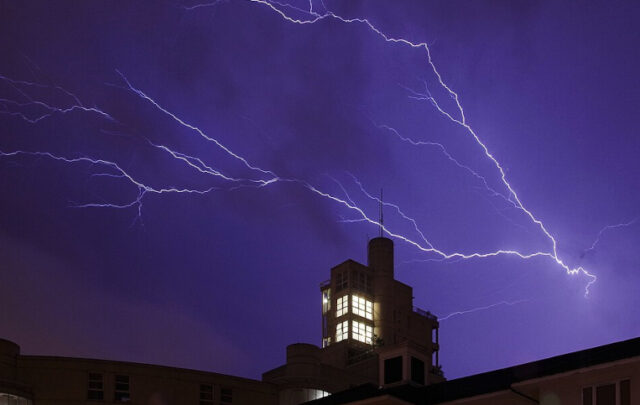


The peak oil crisis: the Gulf Stream
Tom Whipple, Falls Church News-Press
A couple of months back I discussed the North Atlantic Oscillation and how the British Meteorological Office was very concerned a flattening of the Atlantic’s high and low pressure areas was going to make for an exceptionally cold winter in Northern Europe. This phenomenon also allows frigid Canadian air to make its way into the northeastern US resulting in higher prices for heating oil, diesel, gasoline, natural gas and nearly everything else. Winter is now two weeks away, and the British Meteorologists are still holding to their forecast of an unusually cold winter.
Last week, however, a new and more disturbing report was published by the Southampton Oceanography Centre in the UK concerning the stability of the Gulf Stream – a major heat source keeping Northern Europe from becoming Northern Siberia . It seems that since the last time they took measurements 12 years ago, the flow of fresh water from the melting of the north polar ice cap has interfered significantly with the Gulf Stream . Some 30 percent of the Stream’s warm water is no longer making it to the vicinity of Northern Europe , but is being diverted back towards the equator.
A drop of 30 percent in the flow should have been enough to cause an as-yet-to-happen drop in the average North European temperature. Some suggest the increasing world wide average temperature- global warming- is enough to offset the loss of heat from the Gulf Stream as far as Europe is concerned.
(8-14 December 2005)
Exxon and Bushco lobbying efforts to kill Kyoto in Europe revealed
Jerome a Paris, Daily Kos
Both the Independent and the Guardian have stories this morning about recent efforts by ExxonMobil-funded and Bush-friendly lobbyists to try to influence European companies abnd EU regulators about the future shape of the Kyoto treaty after it expires in 2012.
If it all sounds eerily familiar, that’s because it is – it’s a replica of their successful efforts in the 1990s in the US to kill US participation to the treaty.
But the netroots can fight back.
(8 December 2005)
Near record amount of press attention to climate change in 2005
Matthew C. Nisbet, Boiling Point
While spending time with Lexis-Nexis over the past 48 hours, I decided to take a peek at where climate change rests on the overall news agenda for 2005, and where it falls relative to coverage historically. A rough way to estimate media agenda status is to look at the elite newspapers, specifically the New York Times and Washington Post. These papers serve an important “media agenda-setting” influence in that other news media–including broadcast and cable news, news magazines, and other newspapers-look to these papers as stand-ins for the “news of the day.” In addition, these two newspapers, with their large stable of science, business, and political reporters are considered a model for science and technology reporting, and syndicate many of their stories to regional and local newspapers.
So considering record average temperatures and Hurricane Katrina, where did climate change stand on the news agenda relative to past years, and in 2005, relative to other major news stories? (At least through Dec. 6, when I ran these searches.)
…So according to these preliminary figures, in 2005, climate change received its second highest level of news attention historically.
(8 December 2005)
Scientists: Greenland glaciers retreating
Alicia Chang, Associated Press via Common Dreams
SAN FRANCISCO – Two of Greenland’s largest glaciers are retreating at an alarming pace, most likely because of climate warming, scientists said Wednesday. The other glacier, Helheim, is retreating at about 7 miles a year – up from 4 miles a year during the same period.
“It’s quite a staggering rate of increase,” Hamilton said at the American Geophysical Union annual meeting.
Glaciers play a major role in discharging water into oceans. Sea levels have swelled globally an estimated 4 inches to 8 inches during the past century due to melting glaciers and polar ice – enough to cause some places to be awash at high tide or during severe storms.
Melting of Greenland ice and calving of icebergs from glaciers is responsible for about 7 percent of the annual rise in global sea level.
Global warming is frequently blamed for retreating glaciers around the world. The rapid retreat of Greenland glaciers suggest that climate change is a factor, Hamilton said.
(8 December 2005)
Food crisis feared as fertile land runs out
Kate Ravilious, The Guardian
Maps show 40% of Earth’s land is used for agriculture
Growing human ‘footprint’ a risk to the environment
————-
New maps show that the Earth is rapidly running out of fertile land and that food production will soon be unable to keep up with the world’s burgeoning population. The maps reveal that more than one third of the world’s land is being used to grow crops or graze cattle.
Scientists at the University of Wisconsin-Madison combined satellite land cover images with agricultural census data from every country in the world to create detailed maps of global land use. Each grid square was 10 kilometres (6.2 miles) across and showed the most prevalent land use in that square, such as forest, grassland or ice.
“In the act of making these maps we are asking: where is the human footprint on the Earth?” said Amato Evan, a member of the University of Wisconsin-Madison research team presenting its results this week at a meeting of the American Geophysical Union in San Francisco.
The current map shows a snapshot of global land use for the year 2000, but the scientists also have land use data going back to 1700, showing how things have changed.
“The maps show, very strikingly, that a large part of our planet (roughly 40%) is being used for either growing crops or grazing cattle,” said Dr Navin Ramankutty, a member of the Wisconsin-Madison team. By comparison, only 7% of the world’s land was being used for agriculture in 1700.
(6 December 2005)
Canada’s standard of living hard on Earth, report says
The Globe and Mail
Hamilton — If everyone in the world enjoyed Canada’s standard of living, it would take four Earths to supply our needs and dispose of our waste.
That’s the finding of a study by the Federation of Canadian Municipalities measuring the ecological footprint of 20 major municipalities and urban regions.
(5 December 2005)
Strange, New Carnivore Species Sighted on Borneo – Under Threat From Palm Oil Plantations
Reuters, Planet Ark
Environmental researchers are preparing to capture what they call a new, mysterious species of carnivore on Borneo, the first such discovery on the wildlife-rich Indonesian island in over a century.
…
Researchers hope to confirm the discovery by setting cage traps to catch a live specimen, but warn that Indonesian government plans to clear the rainforest to create the world’s largest palm oil plantation may interfere with plans, WWF said. The proposed plantation scheme, funded by the China Development Bank, is expected to cover an area of 1.8 million hectares, equivalent to about half the size of The Netherlands, said the WWF, formerly known as the World Wide Fund for Nature.
(6 December 2005)
Fuel for thought
Liz Stevens, Star-Telegram
From the french-fry vat to the inside of their gas tanks, celebs like Morgan Freeman and Willie Nelson, as well as college students and ordinary joes, are taking up the cause of biodiesel. But is it really better for the environment?
—
In the far back office of the Carl’s Corner truck stop on Interstate 35 East, Carl Cornelius sits at a desk, taking calls on a speaker phone and chain-smoking Pall Malls.
“You gotta dream,” insists Cornelius, who is lately dreaming of an entire town — his — built on the promise of, well, french fry grease.
(11 December 2005)
George Monbiot should be credited with writing something of a watershed article about Peak Oil towards the end of 2003. Perhaps his recent article on the environmental damage caused by certain biodiesels may have opened the debate on this issue more widely also. -AF